
Why Are Delhi NCR Factories Switching to Manufacturing ERP?
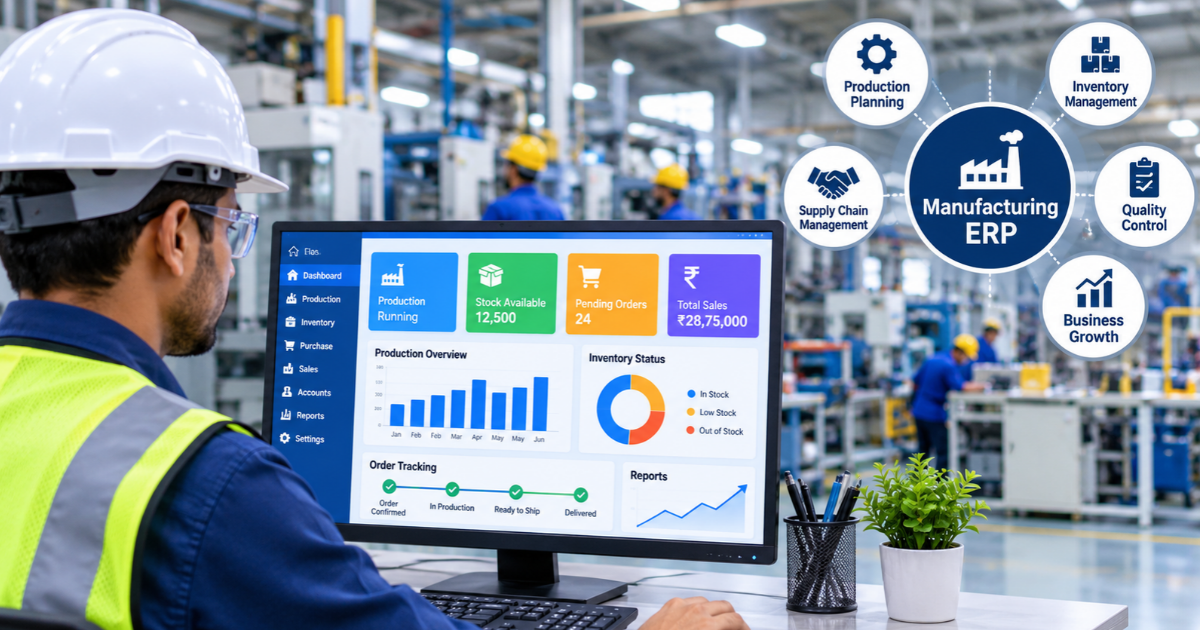
Walk through a factory floor in Noida, Gurugram, Faridabad, or Ghaziabad and you will notice a quiet shift. Clipboards and scattered Excel files are disappearing, and shared dashboards are taking their place. The reason is simple: Manufacturing ERP in Delhi NCR has moved from a nice-to-have tool to a core operating system for plants that want to stay profitable. Rising material costs, tighter delivery windows, and GST compliance pressure leave little room for guesswork. This article explains what is driving the switch, which industries are leading it, and how your team can approach it with confidence.
Why Delhi NCR Factories Are Leaving Spreadsheets Behind
For decades, most plants in the region ran on a mix of Tally entries, Excel sheets, and WhatsApp messages. That approach worked when order volumes were small and customers were forgiving. Today it creates delays that owners can no longer absorb.
The Hidden Cost of Disconnected Tools
When purchase, stores, production, and accounts each keep their own records, nobody sees the same numbers. A stock count in the warehouse may differ from the figure in accounts, and a production supervisor may learn about a material shortage only after a machine stops. Each of these gaps costs money through idle labour, rush freight, and unhappy buyers. Over a year, the loss is far larger than the price of a proper system.
Competitive Pressure from Every Direction
Large buyers in automobile, electronics, and engineering supply chains now ask for traceability, on time delivery data, and quality records. Suppliers who cannot produce these reports quickly lose contracts to those who can. Meanwhile, the growth of industrial belts around Noida, Sonipat, Bahadurgarh, and Manesar means more rivals competing for the same orders. Factory owners see ERP as the fastest route to matching the standards their customers expect.
Rising Compliance and Reporting Demands
GST filing, e-invoicing, and e-way bills have made accurate records a legal need rather than a choice. Auditors and lenders also expect clean data, and banks increasingly review stock statements before sanctioning working capital. Plants that keep these records by hand spend days each month on reconciliation, and still risk errors that attract notices.
What a Modern ERP Delivers on the Shop Floor
Factories that invest in Manufacturing ERP in Delhi NCR gain a single source of truth for every department. Instead of chasing updates through calls and messages, managers open one dashboard and see orders, materials, machines, and cash in the same view.
Production Planning and Bill of Materials Control
The system converts a sales order into a production plan, checks the bill of materials, and flags any shortage before work begins. Planners can compare capacity with demand, adjust schedules, and track work in progress across shifts. Rework drops because every operator follows the same approved recipe or drawing.
Inventory, Purchase, and Quality in One View
Real time stock levels reduce both stockouts and dead inventory. Purchase teams raise orders based on actual consumption, while quality teams record inspection results against each batch. If a defect appears at the customer end, the batch history shows exactly which supplier lot and machine were involved.
GST Ready Finance and Reporting
Invoices, e-way bills, and tax reports flow from the same data that production uses. This removes duplicate entry, cuts reconciliation time at month end, and gives owners accurate costing for each product line instead of rough estimates.
ERP for MEP Companies in Delhi NCR: Controlling Multi-Site Projects
Mechanical, electrical, and plumbing (MEP) contractors manage multiple project sites, detailed bills of quantities (BOQs), subcontractors, material requirements, and long payment cycles simultaneously. Traditional spreadsheets often struggle to handle this complexity as businesses expand. An ERP for MEP Companies in Delhi NCR helps centralize project planning, inventory, procurement, budgeting, subcontractor management, and billing in one system. This enables contractors to monitor project costs, track materials across sites, manage payments more efficiently, and maintain better control over deadlines as they take on more projects.
Estimation, Procurement, and Site Material Tracking
A project focused system lets estimators build costed quotations from a common item master, then convert approved quotes into purchase requisitions. Site engineers record material receipt and consumption daily, so the head office knows what is installed, what is pending, and what is wasted.
Billing Against Progress
MEP firms are paid on measured progress, so billing accuracy decides cash flow. Integrated measurement books, running account bills, and retention tracking help finance teams raise correct invoices faster and follow up on dues without confusion.
Fabrication and Field Work Together
Many NCR contractors also run in house fabrication shops for ducting, panels, and pipe spools. A combined platform lets them manage the workshop and the site together, which is why shop and field teams are adopting one shared system instead of two disconnected ones.
ERP for Construction Industry Firms: Costing and Site Visibility
Delhi NCR is among the busiest construction regions in India, with housing, metro, warehousing, and road projects running side by side. Contractors here face thin margins, so small leaks in cost control quickly become real losses.
Budget Versus Actual Costing
Every work package carries a budget, and each purchase, labour entry, and equipment hour is booked against it. Project heads see overruns while there is still time to act, rather than discovering them at project closure. Monthly margin reports become reliable because every cost is captured in the same place.
Subcontractor and Equipment Management
Work orders, measurements, and payments for subcontractors stay in one record, which prevents duplicate payment and disputes. Heavy equipment usage, fuel, and maintenance schedules are also logged, so owners know which machines earn their keep and which ones drain the budget.
Document and Approval Control
Drawings, change orders, and approvals are stored centrally with version history. Everyone on site works from the latest drawing, and rework caused by outdated documents falls sharply. Approvals that once travelled by courier or chat now move in hours, which keeps work on schedule. Clear audit trails also protect contractors when clients raise disputes about scope or timelines.
Cloud and Mobile Access Are Changing the Decision
Older systems needed heavy servers, long installations, and dedicated IT staff, which put them out of reach for many mid sized plants. Cloud platforms removed that barrier. Owners can now check production status, approve purchases, and review receivables from a phone, even when travelling between plants or sites.
Subscription pricing has also lowered the entry cost, and updates arrive without disruption. Mobile apps let supervisors record output, store keepers update stock, and site engineers log progress on the spot, so data is captured where work happens and not retyped later in the office.
Key Benefits Factories See After the Switch
Owners who have completed a rollout often describe the same set of gains. IBSB Technology works with manufacturers and contractors who value these practical outcomes:
- Faster order to delivery cycles because planning, stores, and dispatch share live data
- Lower inventory carrying cost through accurate reorder levels
- Fewer production errors thanks to standard processes and approvals
- Quicker month end closing with automatic postings between departments
- Better cash control through clear receivable and payable ageing
- Stronger customer confidence from batch traceability and timely reports
- Management decisions backed by dashboards instead of guesses
These gains compound over time. A plant that saves a few hours a day on reporting, avoids one major stockout each quarter, and recovers delayed payments sooner will usually see the effect on profit within the first year. Employees benefit as well, because routine chasing and manual entry give way to analysis and problem solving.
Questions to Ask Before You Sign
Ask for a demonstration using your own sample data. Check whether the platform handles bills of quantities, running bills, and subcontractor work orders. Confirm local GST support, role based access, and mobile access for site engineers. Request references from companies of similar size in the region, and speak to them directly about their experience after go live.
Training and Support Decide Adoption
A rollout succeeds when users trust the system. Look for structured training, clear documentation, and responsive support within the NCR region. A vendor that answers quickly on the first difficult day builds the confidence your team needs to keep using the software.
ERP for Construction Industry Growth: A Practical Rollout Plan
IBSB Technology recommends a phased approach, because attempting to change every process in one month overwhelms teams and invites resistance.
Start with a Process Audit
List how orders, purchases, stock, and billing work today. Mark the steps that cause delays or errors. These pain points become the first priorities, and they give the project a clear, measurable goal. Involve operators and supervisors in this step, since they know where the real bottlenecks sit and are more likely to support the change when their input is heard.
Pilot, Then Scale
Begin with one plant, one project, or two core modules such as inventory and production. Train a small group, collect feedback, and fix issues early. Once results are visible, extend the system to more departments and sites. Celebrate early wins openly so that other teams see the value and ask to join.
Build Adoption Habits
Assign a champion in each department, review dashboards in weekly meetings, and retire old spreadsheets on a fixed date. When leaders use the system daily, the rest of the team follows.
Conclusion
Delhi NCR factories are switching because the old way of working no longer protects margins or customer trust. Integrated planning, live inventory, and clean compliance data give plants a level of control that spreadsheets never offered. If you are ready to explore manufacturing ERP in Delhi NCR for your own operation, IBSB Technology can help you map your processes and choose a rollout path that fits your size and budget. Start small, measure results, and expand with confidence.
Frequently Asked Questions:
1. How long does an ERP implementation take for a factory?
Most factories go live in eight to sixteen weeks depending on the number of modules, the data to be migrated, and the size of the team being trained.
2. Is ERP suitable for small and medium manufacturers?
Yes, because cloud based systems let smaller plants start with core modules and add more as their order volumes and teams grow.
3. Which modules should a manufacturing ERP include?
Look for production planning, bill of materials, inventory, purchase, quality control, sales, and finance with GST support as the essential core.
4. Does ERP help with GST and e-way bill compliance?
Yes, a good system generates GST invoices, e-way bills, and returns data directly from your transactions, which reduces manual errors and filing delays.
5. How much does ERP cost for a factory in Delhi NCR?
Cost depends on users, modules, and customisation, so the best approach is to share your requirements with vendors and compare scoped quotations.